

Texas Hold’em Terminology
Texas Hold’em Terminology:Texas Hold’em is a game that combines skill, strategy, and psychology, and mastering the essential terminology is crucial to success.
In this game, each player uses two hole cards and five community cards to form the best possible five-card hand.
Understanding poker terms not only helps you communicate effectively at the table but also improves your overall gameplay and decision-making.
Below are some fundamental Texas Hold’em terms and their explanations:
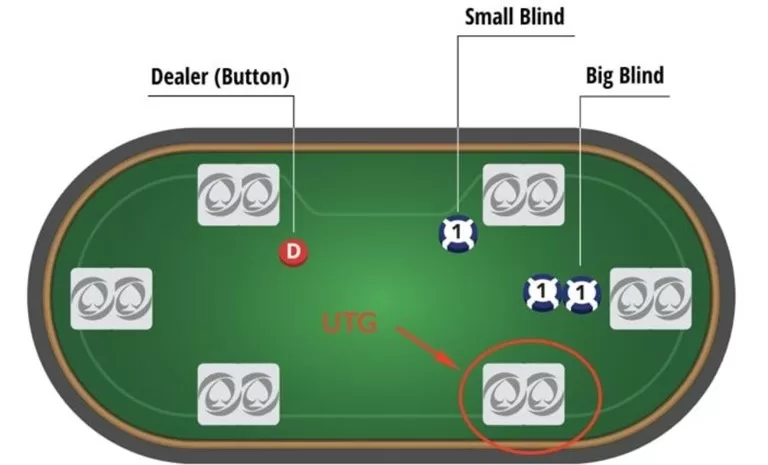
Texas Hold’em Position Terminology
Small Blind – SB
The first player required to post a bet at the start of the game, usually seated immediately to the left of the dealer button.
Big Blind – BB
The player who posts the big blind, seated directly to the left of the small blind. The big blind is typically twice the size of the small blind.
Under the Gun – UTG
The first player to act after the big blind. This is considered the most disadvantageous position because the player must act first before seeing what others do.
LowJack – LJ
The position immediately to the right of the UTG player. This position is slightly better than early position, allowing for a somewhat wider hand range.
HighJack – HJ
The position to the right of the Cutoff. This is a favorable position that allows for more strategic plays, such as steals or re-raises.
Cutoff – CO
The player seated directly to the left of the Button. This is one of the most advantageous positions in poker, second only to the Button, and is often used for stealing blinds.
Button – BTN (Dealer)
The last player to act in each betting round. The Button position holds the greatest advantage in the game due to having the most information before making decisions.
Texas Hold’em Game Stage Terminology
Understanding these stages and terms will help players make smarter decisions and increase their chances of winning the pot.
Preflop
The stage where players only have their two hole cards, and no community cards have been dealt yet.
Flop
The stage when the first three community cards are dealt face up on the table.
Turn
The stage following the Flop, when the fourth community card is revealed.
River
The final stage of the hand, where the fifth and last community card is dealt.
Texas Hold’em Action Terminology for Each Stage
During each stage of dealing in Texas Hold’em, players can take five different actions. These actions include bet, fold, raise, call, and check. Understanding these fundamental terms is essential for every player, as they form the foundation of poker strategy.
Bet
If no player has placed a bet, a player may choose to bet to start a round of wagering.
Fold
If a player believes their hand is not strong enough, they can choose to fold and forfeit their chance to continue in the current round.
Raise
If another player has already placed a bet, a player can choose to raise, increasing the amount of the current wager.
Call
If another player has already bet or raised, a player can choose to call, matching the amount of the previous bet.
Check
If no player has bet during the current round, a player can choose to check—passing the action to the next player without wagering any chips.
Texas Hold’em Betting Terminology
Understanding advanced poker betting terms is crucial for improving your strategy and gameplay. These terms include VPIP, PFR (Preflop Raise), 3-Bet, C-Bet (Continuation Bet), Open Raiser, Donk, Squeeze, Bluff, and Semi-Bluff.
VPIP (Voluntarily Put Money in Pot)
Represents how often a player voluntarily invests chips into the pot, indicating their level of activity and looseness.
PFR (preflop raise)
Refers to the frequency of a player’s raises before the flop.
3BET
Denotes the third bet in a single betting round — a re-raise over an initial raise.
C-Bet (Continuation Bet)
A bet made on a subsequent street (usually the flop) after being the aggressor in the previous round, to maintain pressure on opponents.
open raiser
The first player to raise before the flop, initiating the action.
Donk
A bet made by a player who was not the aggressor in the previous round, typically leading into the preflop raiser on the next street.
Squeeze
A re-raise made by a late-position player after one player has raised and another has called, aimed at forcing both to fold.
Bluff
Betting or raising with a weak hand to make opponents believe you have a strong one, with the goal of making them fold.
semi-bluff
Bluffing with a drawing hand that could become strong if certain community cards appear, allowing flexibility to continue if improved.
Common Poker Terms You’ll Hear at the Table
IP (In position)
Having positional advantage — acting after your opponents, giving you more information before making decisions.
OOP (Out of postion)
Lacking positional advantage — acting before your opponents, making it harder to gather information.
Straddle (Blind Bet)
An optional blind bet made by the player immediately after the big blind, usually twice the size of the big blind, creating more action and a larger pot.
Value Bet
A bet made when you believe you have the best hand but want to size it just right to entice weaker hands to call, maximizing your profit instead of scaring opponents away.
Nuts
The strongest possible hand given the current community cards. Hitting the “nuts” means you have the unbeatable hand for that round.
Gutshot (Inside Straight Draw)
A draw that requires one specific card in the middle to complete a straight.
Example: You hold 6♣7♣ and the board shows 4♠5♦8♥ — you need a 9 or 3 to complete the straight.
Overpair (OP)
A pocket pair higher than any card on the board.
Example: The board is 7-8-9, and you hold pocket tens (TT).
Set
Three of a kind made using a pocket pair and one matching card from the board — concealed because it’s not obvious from the community cards.
Backdoor
Completing a strong hand (like a flush or straight) by hitting the required cards on both the turn and the river.
Blank
A community card that doesn’t affect the strength of the hands in play.
Miss Draw
Failing to hit the card you needed to complete your draw.
Bad Beat
Losing with a very strong hand against a statistically weaker one due to an unexpected card on the turn or river.
Chop
When two or more players have hands of equal value, and the pot is split evenly among them.
On Tilt
A mental state where a player becomes frustrated or emotional, often leading to reckless or irrational play.
Sitting out
Temporarily leaving the table — often due to breaks, rest, or personal reasons.
Fish
A slang term for inexperienced or weak players who often make mistakes. It can be seen as derogatory, so use it with caution.
Shark
A highly skilled player who frequently wins and preys on less experienced opponents.
Reg / Regular
A frequent player at the tables — not necessarily a professional, but experienced and knowledgeable about the game.

FAQ About Texas Hold’em Poker Terminology
Q1: Can I play at the table without knowing poker terminology?
Of course! As long as you understand the rules, you can still play even if you don’t know all the poker terms. However, other players might see you as a “fish” — an easy target — since terminology is the common language among poker players.
Q2: Why should I learn poker terminology?
Knowing poker terminology helps you understand what other players are saying at the table, allowing you to follow the action more clearly. Plus, let’s be honest — it also makes you look like a pro!
Q3: Are poker terms the same all over the world?
For the most part, yes. While local languages may have their own slang or variations, English poker terminology is universally recognized and widely used in both live and online games.
Q4: Are the terms used in online poker the same as in live poker?
Generally, yes. However, online poker often includes additional terms related to digital statistics and data tracking — things you wouldn’t see in live poker — such as VPIP, PFR, or HUD references.
Q5: I’ve learned the terminology, but I don’t know where to play — what should I do?
You can download the Red Dragon Poker app — a premier online poker platform where you can start playing Texas Hold’em anytime, anywhere. The app automatically pairs you with different players for each round, so you’ll never have to worry about finding a game.
Red Dragon Poker APP Officially Launched
The long-established tournament brand Red Dragon Cup has now released its own app — “Red Dragon Poker.”
The Red Dragon Cup is a well-known Asian poker brand with a strong reputation across the region. Originating in Macau, it quickly became one of the most influential poker events in Asia. Red Dragon Poker tournaments regularly attract players from all over the world, offering massive fields and impressive prize pools.
For those interested, we highly recommend downloading the “Red Dragon Poker” app to join more exciting tournaments.