
Learn Texas Hold’em Rules and Strategies in 5 Minutes
Texas Hold’em Rules:Texas Hold’em, often simply called Hold’em, is the most popular poker game in the world and one of the official events in international poker tournaments.
Every year, countless Texas Hold’em competitions are held around the globe. Many poker enthusiasts even travel internationally just to participate in major series events—showing how immensely popular and competitive this game truly is.
Introduction to Texas Hold’em
Each player begins with two private cards dealt face down. Through a series of betting rounds, five community cards are gradually revealed on the table.
The goal is to form the strongest five-card hand possible using any combination of your two hole cards and the five community cards.
When learning Texas Hold’em, understanding the hand rankings is essential. From strongest to weakest, they are:
Royal Flush, Straight Flush, Four of a Kind, Full House, Flush, Straight, Three of a Kind, Two Pair, One Pair, and High Card.
A solid betting strategy is also key to winning. Beginners should learn when to call, raise, or fold.
At different stages of the game, knowing how to make the best decision based on your hand strength and potential opponent holdings requires both practice and experience.
Lastly, mental discipline plays a vital role in Texas Hold’em. Observing opponents’ behavior patterns, staying calm, and not being swayed by others’ tactics will help you maintain an edge at the table.
This brief guide serves as a foundation for beginners—helping you get started and enjoy the excitement of Texas Hold’em.
Number of Players in Texas Hold’em
A game of Texas Hold’em requires at least two players to start — this is called heads-up, meaning a one-on-one match, which is a true test of skill and strategy.
When the table is full, it’s referred to as a full-ring game, where the pot tends to grow larger and players are generally more active.
A 6-max game allows up to six players, featuring a faster pace and greater emphasis on individual skill and aggression.
Texas Hold’em Hand Rankings
In Texas Hold’em, you can win either by forcing your opponents to fold through betting or by having the strongest hand at showdown.
Here are the poker hand rankings from strongest to weakest:
– Royal Flush: A, K, Q, J, 10 of the same suit.
– Straight Flush: Five consecutive cards of the same suit.
– Four of a Kind: Four cards of the same rank.
– Full House: Three of a kind plus a pair.
– Flush: Five cards of the same suit, not in sequence.
– Straight: Five consecutive cards of mixed suits.
– Three of a Kind: Three cards of the same rank.
– Two Pair: Two different pairs.
– One Pair: Two cards of the same rank.
– High Card: When no combination is made, the highest card wins.
Knowing these hand rankings is essential — they are the foundation for determining the winner at showdown.
Texas Hold’em Rules
Texas Hold’em is played with a standard 52-card deck, excluding jokers. The deck is shuffled after every round. While up to 22 players can technically participate, a typical table consists of 2 to 10 players.
The main goal is to win the pot, which is the total amount of chips bet by all players in a hand. You can win either by having the strongest hand at showdown or by forcing all opponents to fold through strategic betting.
To ensure consistent action and prevent players from folding too often due to weak hands, Texas Hold’em uses the small blind (SB) and big blind (BB) system. These are forced bets placed before the cards are dealt. The player to the left of the dealer button posts the small blind (0.5 big blind), and the next player posts the big blind (1 big blind).
Winning Conditions in Texas Hold’em
By betting: You win if all other players fold, leaving you as the last remaining player.
By showdown: If two or more players remain after the final betting round, each reveals their cards. The player with the best five-card hand (using any combination of their two hole cards and the five community cards) wins the pot.
The strategic depth of Texas Hold’em comes from using community cards to build your hand while analyzing your opponents’ betting patterns. Position is a major factor—players acting later in the round have more information and therefore a strategic advantage.
1. Determining the Button
At the start of the game, all players draw a card. The player who draws the highest card becomes the dealer (Button). The dealer button is placed in front of this player.
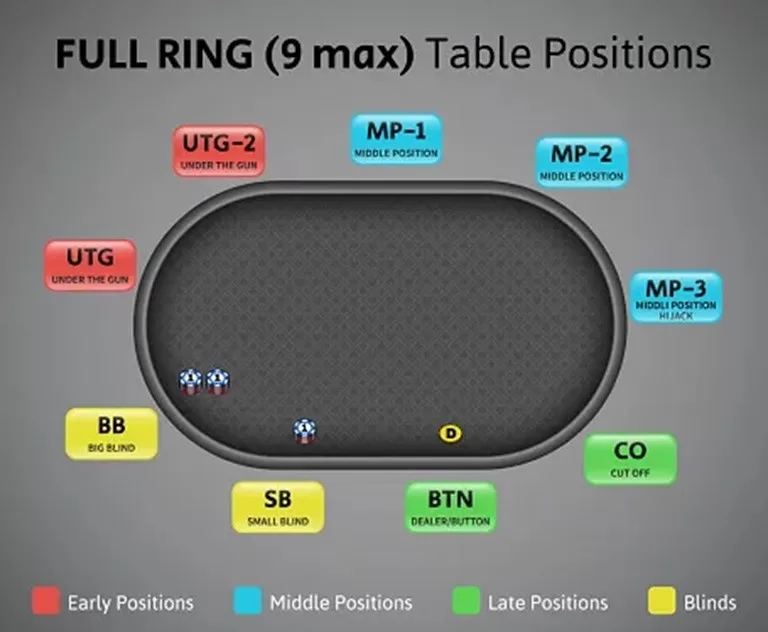
In Texas Hold’em, each seat at the table has a name and position, which rotates clockwise after every hand.
2. Posting the Blinds
The player to the left of the Button is the Small Blind (SB).
The next player is the Big Blind (BB).
Before the cards are dealt:
The Small Blind posts 0.5 big blind.
The Big Blind posts 1 big blind.
The blind structure can vary, but players typically start with 100 big blinds in chips.
For example, if the blinds are 10/20, each player would buy in with at least 2,000 chips.
3. Dealing the Cards
The dealer begins with the Small Blind, dealing one card at a time clockwise until each player has two hole cards.
Once all players receive their cards, the first round of betting begins — this stage is called the pre-flop, meaning the community cards have not yet been revealed.
4. Preflop Betting Round
The preflop phase begins with the player to the left of the Big Blind.
Each player has five possible actions during this stage:
Fold
To fold, you can say “fold” or push your cards toward the dealer.
Be careful not to move your cards too far forward unless you truly intend to fold.
If the dealer accidentally collects your cards, it will be considered a fold, and your hand cannot be retrieved — unless you can immediately state both the rank and suit of your cards correctly.
Check
To check, you can say “check” or tap the table twice with your hand.
Be cautious — some players absentmindedly tap the table while thinking, which can be mistaken as a check.
Remember, the dealer’s judgment is final, so avoid gestures that might cause confusion or cost you the pot.
Call
To call, you can say “call” or place the required amount of chips into the pot.
If a player before you has bet and you silently toss in a single chip, the dealer will treat it as a call.
However, if you throw in multiple chips totaling more than the call amount without declaring “raise”, the dealer may rule it as a raise.
For example:
If a player bets 200, and you silently throw in 500 + 100, the dealer will rule it as a raise — even if you claim it was a mistake.
Some players deliberately use this tactic to confuse opponents, pretending it was accidental.
The best approach is to stick to your strategy and not be misled by such tricks.
Raise
To raise, you can say “raise” or announce the amount you want to raise to, then push the corresponding chips into the pot.
It’s best to declare “raise” first, so the dealer clearly understands your intent.
If you miscalculate or grab the wrong amount of chips without saying “raise,” the dealer might rule it as a call, which could cost you valuable chips.
All-In
To go All-In, you can say “All-In” or push all your chips into the pot at once.
Important: Some players push their chips in stacks without declaring “All-In.”
In that case, the dealer will only count the first stack and treat it as a call or raise, not an all-in bet.
So, always announce “ALL-IN” clearly and move your chips in one motion.
You might wonder:
“If I check at first, and another player later raises, can I still call, raise, or go all-in?”
Yes — this move is called a check-raise.
It’s often used when holding a strong hand, allowing you to build a larger pot.
However, some players also use it as a bluffing technique to make opponents fold — a sign of more advanced play.
5. Flop Betting Round
After the preflop betting round, the game moves to the flop.
The dealer first burns (discards) the top card of the deck — this is done to prevent cheating, such as someone seeing the top card before it’s dealt.
Then, the dealer places three community cards face up on the table. These are shared by all players.
After the three cards are revealed, the betting round begins with the Small Blind, proceeding clockwise.
Each player decides their next move — check, bet, call, raise, or fold — based on the combination of their hole cards and the community cards.
Once all active players have completed their actions, the game proceeds to the turn round.
6. Turn Betting Round
In the turn round, the dealer again burns one card from the top of the deck and places the next card face up beside the existing three community cards.
Now there are four community cards on the table.
The betting starts once again from the Small Blind position, proceeding clockwise.
Players analyze their hands in relation to the four community cards and decide whether to check, bet, call, raise, or fold.
When all remaining players have acted, the game moves to the river round.
7. River Betting Round
In the river round — the final stage of community cards — the dealer burns one last card and places the fifth community card face up beside the others.
Now there are five community cards on the table.
The final betting round begins from the Small Blind position, proceeding clockwise.
Players again choose their action based on the best possible five-card hand they can make from their two hole cards and the five community cards.
Once all players have acted:
If only one player remains, that player wins the pot.
If two or more players remain, they must reveal their hands (called a showdown).
The player with the strongest five-card combination wins the pot.
If two or more players have identical hands, the pot is split equally.
8. Moving the Dealer Button
After each hand, the Dealer Button rotates clockwise to the next player, ensuring everyone takes turns in each position (dealer, small blind, big blind, etc.).
A new round then begins, following the same order of play.
💡 Want to dive deeper?
Check out more in our [Texas Hold’em Terminology Guide], where we explain all the essential poker terms and table slang used by pros.
Texas Hold’em Poker Tips
For beginners just starting out in Texas Hold’em, the following tips and habits can help you become a more unpredictable and strategic player in the eyes of your opponents.
1. Look at Your Cards Only When It’s Your Turn
When the dealer finishes dealing the cards, avoid looking at your hand until it’s your turn to act. Instead, observe the actions of players before you.
Texas Hold’em is a game of information, and this habit provides two major advantages:
(1) Avoid revealing your hand strength too early
Beginners often unintentionally show emotional reactions—like excitement or disappointment—after seeing their cards.
Experienced players can pick up on these subtle cues and use them against you.
(2) Gather information from others first
Watch how players react after looking at their cards — their expressions, movements, and betting amounts.
This allows you to form an idea of each player’s tendencies, possible hand strength, and how you should respond (call, raise, or fold).
Collecting this information consistently will significantly improve your decision-making in long poker sessions.
2. Keep Your Bet Sizes Consistent
To avoid giving away information about your hand strength, try to bet similar amounts regardless of whether you have a strong or weak hand.
Varying your bet size too much can make it easy for observant opponents to read your play patterns.
3. Keep Your Thinking Time Consistent
If you act too quickly or too slowly depending on your hand, you risk revealing information unintentionally.
To prevent this, maintain a consistent decision time before acting — whether you plan to call, raise, or fold.
By doing this, you become as unreadable as a machine, making it much harder for opponents to gauge your intentions.
4. Avoid Unnecessary Movements or Expressions
Some players visibly react after seeing their cards — they might sit up straight, act overconfident when betting, or shake their head when missing a draw.
Even pretending to act can backfire, since experienced players can see through fake tells and exploit your behavior.
Always stay calm, neutral, and composed to avoid leaking any information.
5. Never Voluntarily Show Your Cards
If everyone folds and you win the hand, do not show your cards.
Skilled opponents carefully analyze your play style and decision flow to identify patterns in your behavior.
By revealing your hand, you give them valuable data to use against you in future rounds.
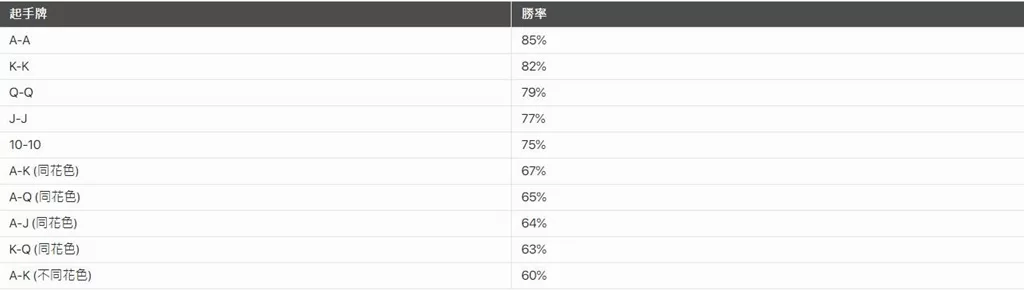
Texas Hold'em hand probabilities

Texas Hold'em Hand Win Rate
Red Dragon Poker APP Officially Launched
The long-established tournament brand Red Dragon Cup has now released its own app — “Red Dragon Poker.”
The Red Dragon Cup is a well-known Asian poker brand with a strong reputation across the region. Originating in Macau, it quickly became one of the most influential poker events in Asia. Red Dragon Poker tournaments regularly attract players from all over the world, offering massive fields and impressive prize pools.
For those interested, we highly recommend downloading the “Red Dragon Poker” app to join more exciting tournaments.